
Today we will learn about types of email marketing. How using these types of email marketing can be beneficial to any organization. These techniques in marketing strategies will boost the revenue and not only that this will help the business also in a long run.
Before starting the topic let us understand what is actually Email Marketing.
Anything that you are promoting through emails mainly your business or product is Email Marketing. There are over 4 billion email users worldwide and if
you are not using email marketing in your marketing strategies you are missing
a lot.
Email Marketing is the best way to keep in touch with your customers; this will also help you notice if your customers' priorities are changing with
time. If this is the case change your plans accordingly.
 |
| Types of Email Marketing |
- Welcome Email
When a buyer
purchases your product or signs up for your service or gets agrees to be part of
your email list. You have to send them an email for welcoming them into your
business as a customer. By doing this you are developing trust with your
customer. Sending a welcome email is a way of introducing your organization
to your customers. Doing this will educate your customer about your brand not
only that it will also help them to understand your product. Check below the example of a welcome email.
 |
| Welcome Email |
How
to Write a Welcome Email
A welcome email
is a crucial type of email marketing. You have to be spot on when you are writing
it. Let’s check out the 10 steps of writing a welcome email
a. Subject
Line
The subject line should be to the point and persuasive. It should encourage your
subscriber or customer to open the email and read it. A good subject line will
automatically increase the open rate of your email hence you have a better
chance to retain a customer.
b. Personalize
your email
Add the user’s
name in your email to make the email like it's written for this specific user only. It
will create confidence in the user for your brand.
c. Having a
gripping opening line
If you can’t
hook your user by the first line of email chances, are they are not going to read
the rest of the mail and all of the hard work will go in vain. Be engaging
persuasive and true to your brand.
d. Thank You
Show your
subscribers that you are grateful for their trust simply by saying “thank you”
that’s powerful enough. You can go one step further by offering them a coupon.
e. Tell Your
Brand Story Well
Have you ever
heard “a story well told is a story well sold” Stories are powerful ways to
drive your sales, and your brand will make your subscribers more emotionally connected
to you? Write an engaging and authentic brand story for your welcome email.
f. Reinforce
benefits
Always address
incentives and reinforce benefits. There is a good chance that your
subscribers have opted in because you promise them a free resource. Make sure
you address this at the beginning of your email. If you can show that you are
grateful, it will have a massive impact on how your subscriber perceives your
value.
g.
Set Expectations for Future Communication
What content
will your subscribers receive from you? How often we will email them? What
gifts they can expect and when? It’s important to set expectations for your
subscribers.
h. Persuade
New Subscriber
Include Call
to Action (CTA) button in your welcome email. Convince your user to connect
with you on social media platforms. This also helps to build brand reputation.
i. Don’t
Include Primary and Secondary CTA
All your
emails should be primary CTA. So, this CTA can be followed by a secondary CTA.
Think of it in this way. What’s the first thing you want your user to do
immediately upon reading your email? That’s your primary CTA. Anything else is
secondary CTA
j. Leave A
Teaser
Build
anticipation, you don’t want your subscriber to lose interest after your first
set of emails. So, when you tell your subscriber what to expect you should make
them curious as well. This way, they will open your next email as well.
Simply you can
say that you have a few special surprises in store. They are going to be good.
And Subscribers should stay connected, so they don’t miss out. It works wonders.
So, as simple
as that. You only get one chance to make a good first impression make sure you
put your best foot forward in your welcome emails.
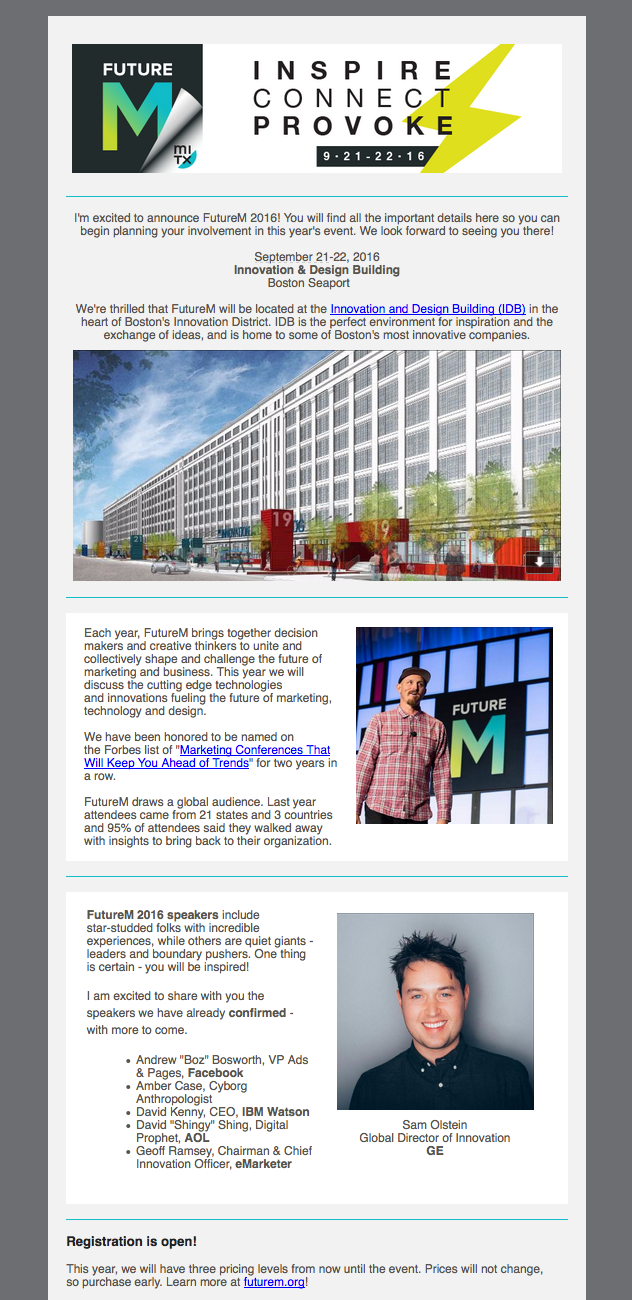
2. Dedicated Email
This type of email marketing strategy focuses on
just one offer. Dedicated email is often called standalone email. Let’s suppose
your organization is planning to put up a seminar about fintech industries in
this case you will only send email to the group of people who were registered
for this event.
A dedicated email will not target the full email list
rather it will target only the group of people that are showing interest in
some specific program. Following is the picture is an example of a dedicated email.

 |
| source: https://blog.hubspot.com/hubfs/futureM-event-invitation.png
|
3. Email Newsletter
An email that you
send to your customer on regular basis is known as an email newsletter. The purpose
of an email newsletter is to keep your audience updated about your products or
business. This type of email marketing technique is also a good way to check the temperature of your
audience not only that you can check how engaged or interested they are in your product from time
to time.
Newsletter can’t be done in an automated fashion like
running an ad campaign. In fact, this type of email marketing strategy is time-sensitive. Let’s discuss some examples of email newsletter
What should you include in the email newsletter? The
answer to this question depends upon what kind of business you are in. If
you have an online store and a sale is coming up that would be good content for
your email newsletter. If you are an owner of a company and changing your logo or
updating the brand of your company that’s a great announcement to put in a
newsletter.
These are the best ways to keep your audience
engaged with. Think of a newsletter as your personal social media platform and
your audience is your own exclusive private audience to talk with. So, use this
platform to talk about your product talk about your business, or services with
your audience, and keep them engaged.
4. Transactional Email
A transactional
email is used to confirm a transaction between you and your subscriber
typically it’s a way of passing on information. A perfect example of this
marketing strategy would be an "order confirmation email" this would be an email
that the customer receives confirming the details of an order that they just
placed from your website.
Normally this type of email marketing is considered as emails
that are used to just pass on important information only. Using them as a way of
selling is often overlooked by most of us. Because we always thought that
selling takes place only on email newsletters and transactional emails are there
to just pass on information.
You may have noticed that some emails that you
receive confirming an online order that you have just placed may also subtly
suggest other products that might be interested in. Now, this technique of
subtly presenting products may really complement the initial purchase that
person has made and is a really superb way of gaining additional sales.
 |
| Source: https://cxl.com/blog/confirmation-emails/ |
Some of the big companies like Amazon have been
doing this for a while and it really works. For example, congratulation on the
purchase of your XYZ product you may also like to consider and then outline
your products. The other way is customers who purchase this product also bought
XYZ. Do try some of these subtle selling techniques to increase secondary sales
if it’s done correctly, it really does work rather well.
5. Lead Nurturing Email
Let me explain this email marketing type with an example. Let’s suppose you visited amazon and added a few products to your cart after that you didn’t complete the purchase and left. Soon you will receive an email from amazon reminding you to complete the purchase this whole process is Lead Nurturing.
Lead Nurturing basically increase the chances of
your potential customer (which in digital marketing is called a lead) to become
a permanent customer. You don’t have to hope that someone will buy your product,
rather you will slowly make up their mind to purchase your product.
In simple words staying with your lead from the
time they visited your store, added something in the cart, or subscribe to a
mail list till the time lead is converted into a sale is lead nurturing. You have
to stay in contact with your customer throughout each of these stages.
Overall, this email marketing type is to build a
relationship with your customer and the aim is to guide them towards making a
purchase.
6. Thank you Email
Whenever a user or a lead performs some action like filling out a form on your website or purchasing a product from your website don’t miss the opportunity to say thank you to your customer. This action will show professionalism from your side and will bring a lot of confidence in customers also. Which more likely will convince the customer also to make the next purchase also from you.
You can add a CTA also in your thank you mail and link it to your upcoming products. In this manner, you will retain the customer also and gives you the chance of generating more revenue.
7. Product Update Email

8. Co-Marketing Email
 |
| source: https://www.linkedin.com/pulse/red-bull-go-pro-smart-alliance-pranali-lokhande |
9. New Content Email
10. Post Purchase Email
Conclusion
Use all of these
email marketing techniques in your marketing campaigns to see the best results.
Do the split testing. Check from which technique you are generating more revenue
and from which you are not getting anything. Optimize the campaigns from where
you are generating revenue and stop the campaign that is not performing or not
bringing sales. Email Marketing is one of the best ways to stay connected with your
audience. Make sure your emails are representing your brand in a way that makes
your customers feel appreciated.
Related Topics
https://adeelanware.blogspot.com/2022/05/successful-email-marketing-campaigns.html
https://adeelanware.blogspot.com/2022/05/earn-money-through-email-marketing_18.html
https://adeelanware.blogspot.com/2022/05/email-marketing-for-beginners.html

.png)



0 Comments